Verify the basics before you talk money
Any contractor walking onto your property needs general liability insurance and a valid state license for asphalt paving work. Ask for a certificate of insurance directly from their carrier and call the number on the document to confirm the policy is active. A license can be checked through the state licensing board online. Workers' compensation coverage is also required if they bring a crew. Without it, you carry the liability if someone gets hurt on your property.
Questions to ask about the paving process
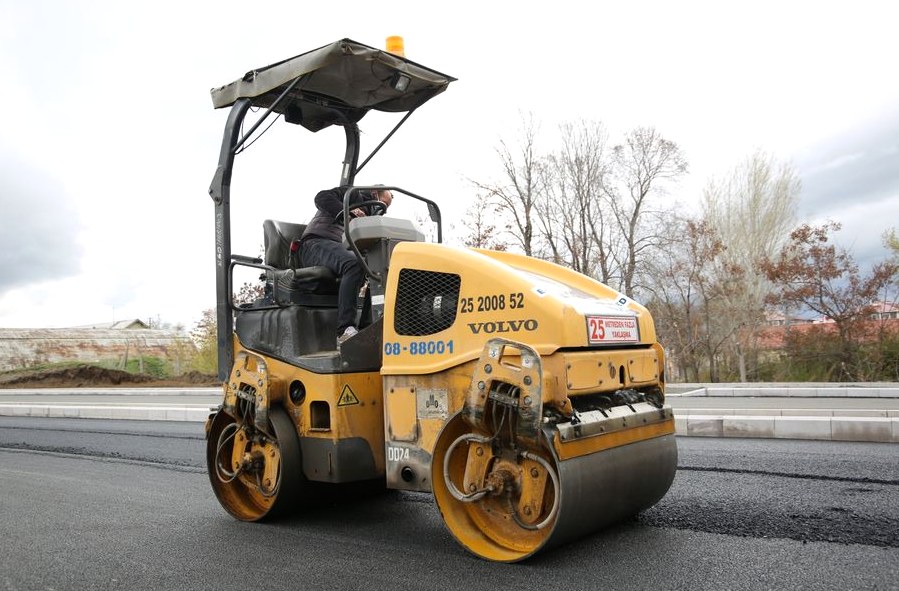
Ask how they prepare the surface and lay the material. Before applying a tack coat, the existing surface must be cleaned using mechanical brooming, compressed air, or water. Once the tack coat is applied uniformly, the crew must allow the emulsion to break before placing the hot mix. Ask about their paving technique. A professional crew keeps the paver moving at a steady speed with a constant head of material and a correctly set screed to produce a uniform mat. For compaction, they should specify using a vibratory steel-wheel roller to hit the required density. If a contractor cannot explain these steps, they are cutting corners.
Red flags on the estimate
Watch for a bid that comes in significantly lower than the others. An estimate with no line items is a warning sign. You need to see exactly what you are paying for, from the base prep to the tonnage of asphalt. Be cautious of anyone asking for full payment upfront. A reasonable deposit covers initial materials, but paying in full before the equipment arrives removes your leverage. Avoid contractors who pressure you to sign immediately to lock in a leftover material discount.
Comparing asphalt repair quotes
When comparing estimates, check the specific scope of work. A quote for pothole repair should run $100 to $400 per pothole, depending on the size and depth of the cutout. If you are looking at crack filling, expect $1 to $3 per linear foot. Make sure each bid includes the same preparation steps. A low bid might skip the mechanical brooming or use a cheaper, unheated tack coat. Verify that the quotes account for Dalton's local conditions. We get occasional winter freezes that bring freeze-thaw movement, so the base preparation and drainage must be factored into the price to prevent the new asphalt from heaving.
Accounting for local soil and weather
Dalton sits on mixed regional soils with moderate moisture retention. If a contractor does not evaluate how water moves through your property's soil, the pavement will eventually fail from below. The subgrade needs to be stable before any asphalt goes down. Because our occasional winter freezes cause freeze-thaw movement, any trapped moisture will expand and crack the surface. A detailed estimate should address grading and base reinforcement to handle these specific soil conditions, rather than just quoting a standard overlay.
Getting Started Is Simple
-
Call or Text
Tell us what you're seeing and when it started — you'll get a straight answer, not a sales pitch.
-
On-Site Inspection
A tech inspects the problem in person — no guessing from photos, no drive-by quotes.
-
Clear, Written Quote
You get the scope and the price in writing before any work starts. No surprises.
-
We Do the Work
Our crew does the work, checks it, and leaves the site clean. You see everything we did.
What this typically involves:
- Before an overlay, repair pavement failures, patch potholes, and thoroughly sweep debris from the surface. [S5]
- Apply tack coat to the clean surface with a calibrated distributor; set the spray bar and nozzles for uniform double or triple overlap. [S4][S5]
What It Typically Costs
Typical ranges, not a fixed price - the exact number is confirmed in writing before work starts.
$1–$2
$7–$13
Related Services
Areas We Serve
Based in Dalton, GA. Call (762) 219-8412 to confirm coverage for your address.
Why Dalton Homeowners Call
- Free EstimatesYou pay for work, never for the quote.
- No-pressure estimatesThe estimate is information, not an obligation.
Need help today? Call (762) 219-8412.
Updated October 2026